
Spring Township Previous Residents by Record Era
For an address-history question, start with the source that matches the time period. Recorded instruments establish a property transfer; a directory or telephone book can suggest who used an address during a specific year; a census is a periodic household snapshot. The table separates those jobs so a tax mailing field, a deed party, and an occupant listing do not get treated as the same kind of proof. Combine sources only after the address, date, and legal description line up.
| Source | Years it covers | Where held | What it shows |
|---|---|---|---|
| Recorder computerized index and images | 1752-present | Berks Recorder online search and counter | Recorded instruments, parties, dates, and document references |
| Recorder original books | 1752-1953 | Berks Recorder | Original handwritten or typed record books |
| Recorder microfilm | 1953-2004 | Berks Recorder | Microfilmed original records |
| State Archives deed and party indexes | Deed books from 1751; grantee 1751-1926; grantor 1752-1926 | PA State Archives public search room and FamilySearch as available | Historic party-to-instrument route |
| Telephone and Reading-area directory layer | 1911-1934 and 1940-1948 documented runs | Library of Congress, RPL, BCGS, and NARA sources | Dated name, address, telephone, and locality clues |
| Federal census | Public through 1950 | NARA and BCGS | Household and relationship snapshot |
A property owner is not automatically an occupant, and a directory listing is not a deed. Past residents research is more reliable when each result is labelled by its source type before a conclusion is drawn.
Start a Spring Township Previous Residents Trail
Begin with the Berks County Property Records Search. It accepts owner name, street address, parcel ID, and map search routes. Capture the current site location exactly as shown, the municipality, UPI or parcel number, legal description or plan and lot details, owner and mailing fields, deed reference, and the date of the search. The mailing address is tax-correspondence evidence and can differ from the Spring Township situs address, so it is not a household list.
Then open the Berks Recorder Advanced Search with the parcel ID, property address, and municipality. The Recorder asks for the 14 to 17 digit Parcel ID without dashes. It also offers Party Names, Grantor, Grantee, recorded-date range, document number, document type, book and page, full-text OCR, municipality, and property-address controls. An address miss should lead to the parcel, legal description, plan, lot, or party fields, not to a guess that the property has no history.
Address-history rule. Keep the parcel UPI and legal description with every deed reference. Street labels and parcel numbers can change, while the legal description often bridges older instruments.
Spring Township Previous Residents in Recorder Records
The Berks Recorder says its computerized image and index trail reaches to the county's 1752 formation. Custody changes by era: original handwritten and typed books cover 1752-1953, original records were preserved on microfilm for 1953-2004, and 2004-forward records are digital with electronic backup. That depth is useful, but searchability varies. Parcel-ID indexing began in 2013, so older property trails often require party names, book and page, plan or lot, municipality, and legal-description searching.
The Recorder of Deeds offers several access channels. Use the public online index to locate an instrument, purchase regular or certified copies online when available, or obtain copies at the counter. Mail requests need the proper fee and a self-addressed stamped envelope; copy-payment escrow is available through the office, and the Recorder can be reached at 610-478-3380. The counter is at 633 Court Street, third floor, Reading, with published hours Monday-Friday, 8:00 a.m.-4:00 p.m. An RTKL request is for existing county administrative records that the specialized recording and copy route does not otherwise supply.
The Pennsylvania State Archives digitized county-records guide is pictured below. It helps route older Berks materials when an online keyword search is not enough.
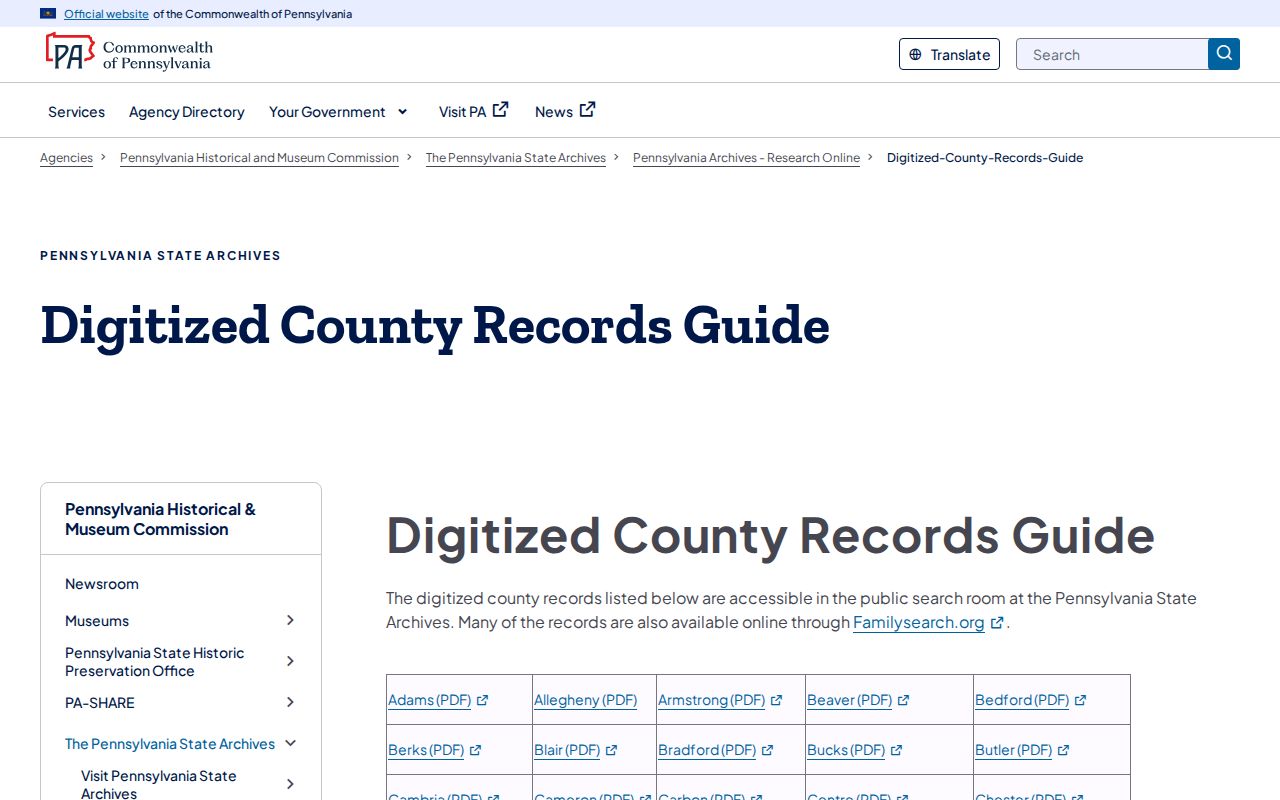
The era split is a practical reminder to move from the online interface to the Recorder or Archives rather than treating a no-result screen as a records gap.
Note: A deed proves a recorded transaction, not that a party was living at the property on every later date.
Trace Past Owners Through Berks Deeds
The backward path follows roles, not merely surnames. In a purchase deed, the buyer is the grantee and the seller is the grantor. To move one step earlier, search the former seller as grantee or use the prior book, page, or instrument reference. Compare the legal description and parcel context at every transfer. Similar addresses, subdivision changes, and recurring family names are reasons to slow down, not reasons to merge two records.
- Pull the current assessment card and write down the site location, UPI, municipality, legal description, plan or lot, current owner, and deed reference.
- Locate the acquisition deed in Recorder Advanced Search using the parcel ID, address, municipality, or current owner as grantee.
- Record the instrument number, recorded date, book and page if shown, grantor, grantee, and the deed's legal-description wording.
- Search that grantor as the next grantee, or follow the prior-deed reference, then repeat the comparison backward.
- For an earlier link, use Recorder books or microfilm and the State Archives grantor-grantee indexes. Search Cumru for tracts before Spring Township existed in 1850.
- Grantor / grantee
- The grantor transfers an interest in a recorded instrument; the grantee receives it.
- Chain of title
- The sequence of recorded ownership transfers and related instruments tied to the same property.
- Legal description
- The lot, plan, metes-and-bounds, or other property wording that identifies land more durably than an old street label.
- UPI
- The county parcel identifier used to connect a property card with Recorder research, subject to parcel changes after subdivision or combination.
State Archives for Spring Township Previous Residents
The State Archives adds the pre-portal layer. Its Berks guide identifies deed books from 1751, grantee indexes for 1751-1926, grantor indexes for 1752-1926, and several unrecorded-deed indexes. It also lists a naturalization index for 1798-1914 and a marriage-license docket index for 1885-1909. Listed digitized county records are accessible in the public search room, and many are available through FamilySearch. Check availability for the exact roll or volume before a trip.
The public-search-room and FamilySearch routes are fallbacks, not substitutes for the county Recorder's specialized copy process. Start there when the evidence points to a time before a convenient online instrument hit, when the party chain has reached a book reference, or when a prior property description needs confirmation.
The Berks History Center collection search is shown below. Its keyword catalog can lead to archival material connected with a surname, place, map, or local-history subject.
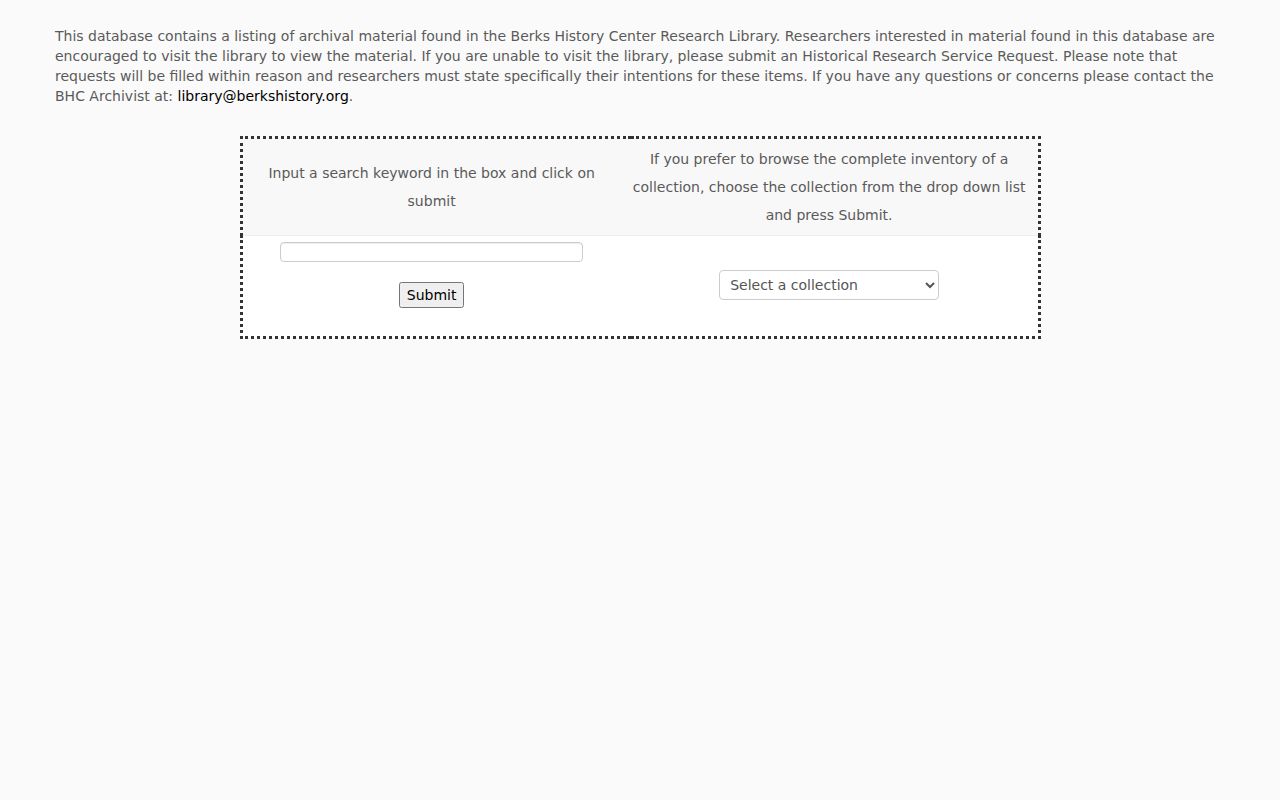
A catalog hit points to a collection or research request. It does not establish that the underlying file is online or that it identifies a former occupant.
Past Households in Spring Township Directories
Ownership is only one layer of who lived at an address. Reading-area directories and telephone material provide dated household clues between transfers. The documented runs include Reading directories for 1929-1933, where Springmont and West Lawn are named suburbs; Reading telephone directories from October 1911 through April 1934; and Reading/Sinking Spring material from 1940 through 1948. A telephone entry can show a name or business, r for residence, street or address, telephone number, and locality heading.
Pair the closest directory year with the nearest public census year and a property record from the same period. Census and directory entries can show people who were not owners, while a deed provides the transfer history. The collections themselves, entry conventions, and research desks are described on the Spring Township city directory page. Avoid assuming a complete criss-cross directory survives for every street, because the research did not verify such a run.
- Place the recorded ownership transfers in date order and leave gaps where no transfer is known.
- Search the closest available directory or telephone year using the source's own locality heading and address format.
- Compare the named listing to the closest public census snapshot, preserving uncertainty when a house number or locality differs.
- Use newspaper, obituary, cemetery, and estate records to test whether a move, death, or spelling change explains a gap.
Lawful use. Previous-resident research is appropriate for house history, family history, estate work, and personal curiosity. Do not use records to track, harass, harm, or expose a living person or someone with a protected address.
Pennsylvania Room Evidence for Previous Residents
The Reading Public Library Pennsylvania Room is an important in-person path for archived city and suburban telephone directories, maps, cemetery, census, church, and family records, plus high-school and college yearbooks. The special collection is noncirculating. Its published hours are Friday 12:00-4:30 and Saturday 9:30-4:00. The room also gives access to some FamilySearch images that cannot be viewed at home through its Affiliate Library computers.
For a dated event, the library has Reading Eagle and Reading Times microfilm back to 1858. Staff remote research needs an exact date. Out-of-county mail or email article requests cost $10 for up to 30 minutes, with a two-hour and $40 maximum; payment may be required in advance even if nothing is found. Call 610-655-6355 or use reference@readingpubliclibrary.org when the address, surname, and event date are narrow enough for a search request.
The Pennsylvania Room collection is pictured here. Its noncirculating directories and maps help bridge gaps between recorded transfers and census years.

The library layer supports a carefully dated address trail. It should not be read as a complete list of every past household.
Spring Township Past Residents in West Lawn
Historic jurisdiction is a documented Spring Township research trap. The Township separated from Cumru Township by court action in 1850, so property material before that year belongs under Cumru as well as the later place name. West Lawn was formerly a borough, then merged into Spring Township after a 2004 referendum and dissolved in 2006. Older maps, directories, newspapers, permits, and locality filters may therefore use West Lawn Borough even though a current parcel says Spring Township.
Keep both names in the research log and test them against the legal description, plan, lot, map, or dated street form. Postal names are also a weak municipal filter: local facilities use Sinking Spring, West Lawn, and Wyomissing mailing labels. The older label can be the key to finding a record, but it should not replace the current county jurisdiction on a parcel record.
Spring Township Address Permits after a Transfer
Township records can date a project or transfer-period condition at an address, but they do not establish a resident roster. Property Transfer Ordinance 341 took effect August 1, 2007. Before a single- or multiple-family dwelling transfer, the Township Codes Department conducts an exterior-observable zoning and property-maintenance inspection. The file can touch visible conditions, permits, sewer connection, allowed dwelling units, and bedroom count, yet none of those fields proves who occupied the property.
The Township permit route supplies forms for building, zoning, demolition, driveway, sewer, and related projects. Applications are not accepted by email; use in-person, mail, or fax submission. For an existing known-address file, the Township Open Records Officer accepts written requests by email, mail, fax, or in person, and the Township says it decides within five business days subject to the state extension process. Name the address, date range, and file type, and expect any exempt personal information to be redacted.
When a permit or inspection date sits between two deed transfers, treat it as a piece of property history. It can support a timeline of changes without turning an owner, applicant, contractor, or complainant into an asserted resident.
Note: Project files are address evidence, not proof that a named applicant lived at the site.